

PEF Survey: First Edition
Hello Everyone!
For starters, I would like to thank everyone who participated in the PEF survey. Although I have fallen short of the initial goal of 100 respondents, but I've found some things worth sharing. I also published a couple of resources that are helpful.
Kaggle Datasets
Until this week, there were zero PFS datasets on Kaggle. Now there are two:
It is free to view and download, and you can open it on your laptop or in Google Drive pretty easily. For those unfamiliar, Kaggle is a popular website where data scientists, researchers, and students apply programming techniques to find patterns in data that are invisible to the naked eye. If these gain traction, it is a way for us to be seen by people with the tools to actually help provide us much-needed answers. The more PFS data on there, the more people have to work with.
PEF Survey Results & Insights
Onset Time: It hits fast— and that is rare.
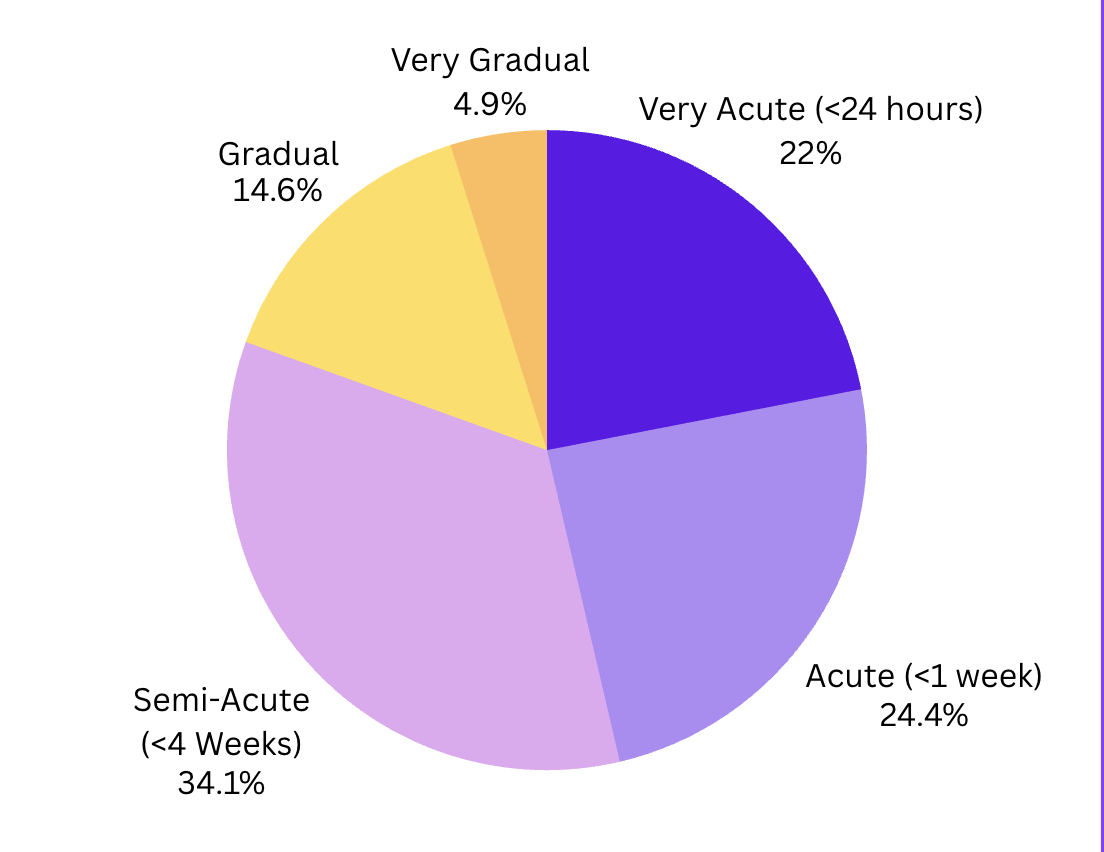
Onset time across PSSD, PFS, PAS and PALMS (n=41)
Nearly half of respondents contracted their post-exposure syndrome within one week. A majority had a rather fast onset at <4 Weeks. When comparing the time of onset to other systemic diseases— this is extremely abnormal. Most systemic diseases do not behave this way. For instance, typical autoimmune diseases (e.g. Lupus) develop gradually over months-to-years. Hypothyroidism, and other endocrine issues, take months. Not even HIV shows symptoms in such a short duration. Generally, only infectious diseases (e.g. common cold) become symptomatic in such a short period. This phenomenon warrants proper research.
Symptom Burden by Diagnosis: PSSD is the most severe, PFS trails slightly behind.
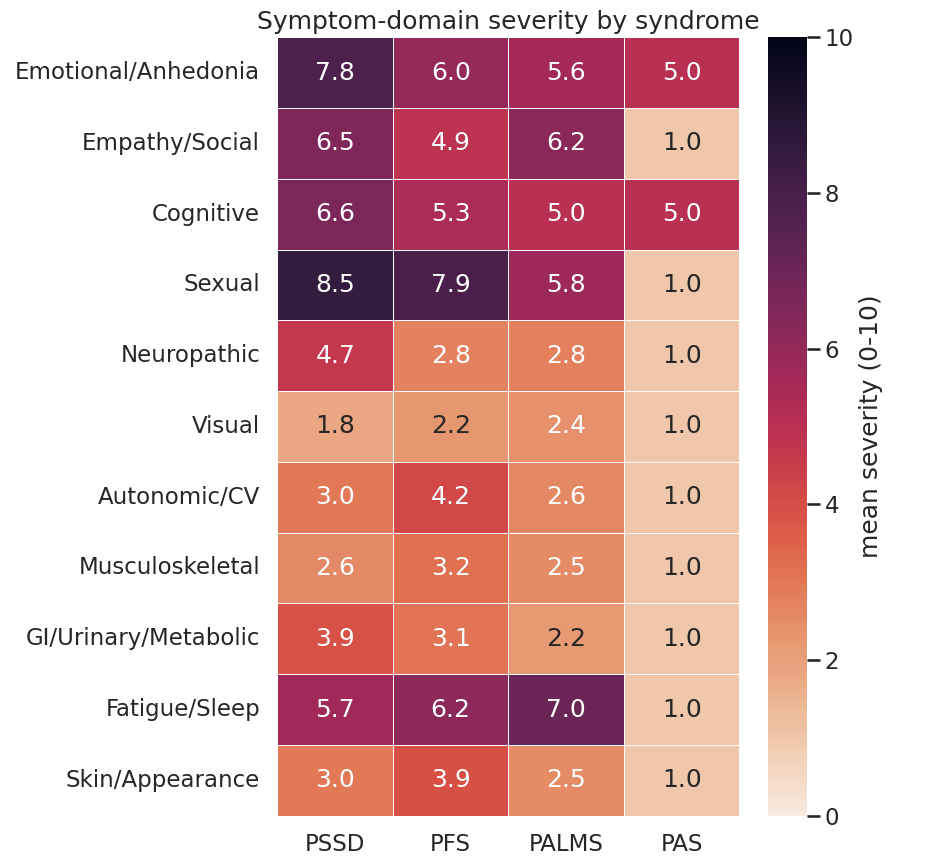
Symptom Heatmap (10 = Severe) (n=46)
The database was split across four diagnoses, all skewing heavily male:
PSSD (n = 23, median age = 34), avg. severity 4.92
Post Ashwagandha/Lions Mane (PALMS) (n = 10, median age = 33), avg. severity 4.05
PFS (n = 12, median age = 33), avg. severity 4.52
PAS (n = 1, age = 31) avg. severity N/A
The symptom heatmap below depicts the average severity per symptom cluster per diagnosis ranging from 0 to 10, with 10 being severe symptoms. Just by glancing, it is evident to see that PSSD takes the cake as the most severe manifestation. A large caveat here is that we only have one respondent for Post-Accutane Syndrome, so a more robust average for symptoms across the PAS community is impossible to gauge at the moment. Furthermore, it is important to keep in mind that every person's experience is unique, and all post-exposure syndromes are debilitating.
As visualized, it is evident that Emotional, Social, Cognitive, Sexual and Fatigue-related symptoms are the most universal. PSSD has a unique discrepancy in regards to neuropathic symptoms, whereas Autonomic and Cardiovascular symptoms are higher in PFS folk, and fatigue seems to be a severe issue in those with PALMS.
Symptoms correlate in interesting ways
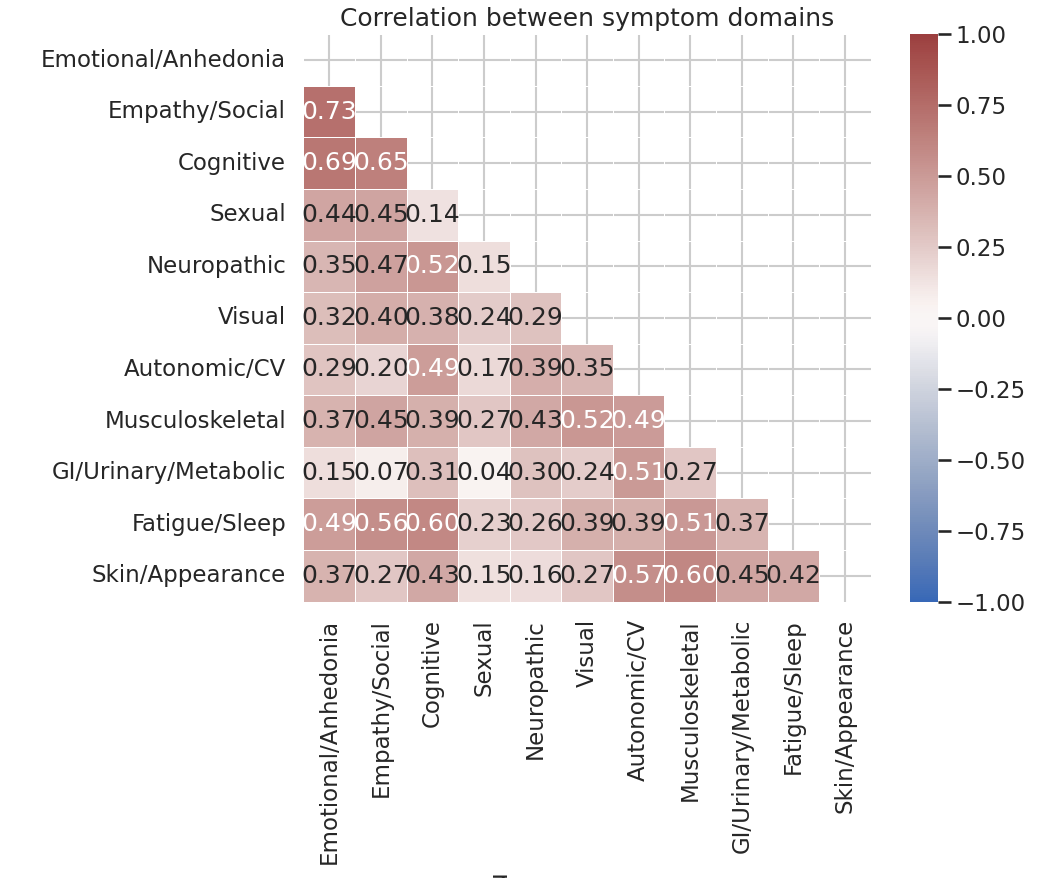
Symptom correlations across PSSD, PFS, PALMS and PAS. 0 = No correlation. 1 = strong correlation. (n=46)
Not everyone here will be familiar with correlation matrices, so I'll skip the explanation and jump to the conclusion: the emotional, mental, and social symptoms tend to come as a package, while the sexual symptoms often run on their own track.
Recovery Database Insights
The database consists of anecdotes posted publicly online from the late 2000s to today. The most common treatments include hormonal treatments, bupropion, and Cyproheptadine. Others have seen success with Ibogaine, Kisspeptin, NSI-189 and Probiotics. None of this is medical advice nor a suggestion to partake in any intervention without medical supervision.
Total Recovery Anecdotes: 825
Distinct Regimens: 465
Most Common Treatment Found: HCG
PSSD/PFS/PAS Ratio: 700:122:14
Recovery levels per most common treatments
Conclusions + TLDR
To be transparent with you, I am lacking data to provide more substantial and groundbreaking insights into this mystery condition. If you haven't, please click here to fill out the PEF Survey— especially if you have done any sort of medical testing.
Again, a big thank you to everyone who has helped with the survey so far, and a special shoutout to my friend at Inida who helped me with the data analysis.
I believe that with the power of data, we'll reach 1,000 recovery anecdotes one day... then 2,000, then 5,000. The answers we're all looking for are missing because the data is missing. The more organized information we have, the harder we are to ignore.
Thank you for reading.
Brain-Fog Friendly TLDR:
PFS has a fast onset. That is unusual in medicine.
PSSD, PFS, PALMS, and PAS are all awful— but PSSD most severe on average
Sexual symptoms independent of other symptoms severity for all diagnoses
Database links under headers
PEF Survey is still open for submissions.
Hormonal treatments, bupropion, and Cyproheptadine are the most common interventions
